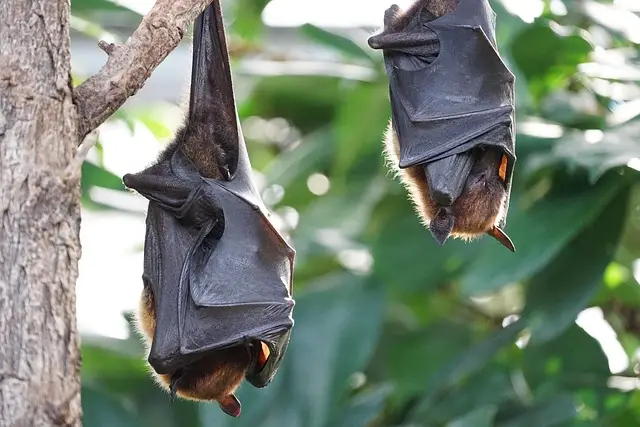
Characteristics of Bat Sound - Ultrasonic Echolocation & Night Calls
Habitat
Caves, forests, urban areas, and diverse habitats worldwide except polar regions
Diet
Insectivore (most species), some are frugivorous, nectarivorous, or carnivorous
Lifespan
10-30 years depending on species, some exceed 40 years
Weight
2-1300 grams depending on species
Length
3-40 cm wingspan, 2.9-180 cm depending on species
Region
Worldwide except Antarctica and extreme polar regions
Bat Sound Characteristics
The bat sound is among the most sophisticated and diverse acoustic systems in the animal kingdom. From the ultrasonic echolocation bat sound used for navigation and hunting to the audible social bat sounds for communication, these nocturnal mammals have evolved an extraordinary vocal repertoire. Each bat sound serves a specific purpose in their survival, from detecting tiny insects in complete darkness to maintaining complex social structures. The bat sound system represents one of nature's most remarkable examples of biological sonar.
Echolocation Clicks
The most distinctive bat sound is the echolocation click, an ultrasonic vocalization used for navigation and hunting. This sophisticated bat sound is produced in the larynx and emitted through the mouth or nose, depending on the species. The echolocation bat sound ranges from 20 kHz to 120 kHz, mostly beyond human hearing range. Bats analyze the returning echoes to create detailed acoustic images of their environment, detecting objects as thin as human hair. This remarkable bat sound system allows bats to hunt flying insects in complete darkness with extraordinary precision.
20,000-120,000 Hz (ultrasonic)
110-140 decibels at source
0.5-20 milliseconds per click
During flight, hunting, and navigation in darkness
Feeding Buzz
The feeding buzz is a specialized bat sound produced when a bat closes in on prey. This rapid-fire bat sound consists of echolocation clicks emitted at rates exceeding 200 per second, creating a distinctive buzzing pattern. The feeding buzz bat sound helps bats make final adjustments to intercept fast-moving insects. This terminal phase bat sound is crucial for successful prey capture and demonstrates the incredible processing speed of the bat's acoustic system. The feeding buzz bat sound is one of the fastest vocal performances in the animal kingdom.
25,000-100,000 Hz
120-140 decibels
Rapid pulses, 200+ per second
During final approach to prey, moments before capture
Social Chirps
Social chirps are audible bat sounds used for communication between colony members. These lower-frequency bat sounds fall within the range of human hearing and sound like high-pitched squeaks or chirps. The social chirp bat sound is used for various purposes including greeting, aggression, courtship, and maintaining group cohesion. Unlike echolocation, these bat sounds are specifically designed for communication and vary significantly between species. Social chirping bat sounds are particularly common in roosts where large colonies gather.
5,000-30,000 Hz (partially audible)
60-80 decibels
0.1-0.5 seconds
In roosts, during social interactions, and territorial disputes
Distress Calls
Distress calls are urgent, high-pitched bat sounds produced when a bat is captured, injured, or in danger. This alarm bat sound is designed to alert other colony members to potential threats and may deter predators. The distress call bat sound is typically louder and more persistent than other vocalizations, ensuring it carries over distance. This emergency bat sound can trigger mobbing behavior in some species, where multiple bats respond to help the distressed individual. The distress call bat sound is crucial for colony survival and predator avoidance.
10,000-50,000 Hz
80-100 decibels
0.2-1 second, often repeated
When captured, injured, threatened, or experiencing acute stress
Mating Calls
Mating calls are specialized bat sounds produced by males to attract females during breeding season. These courtship bat sounds are often complex, species-specific vocalizations that may include songs, trills, and rhythmic patterns. The mating call bat sound serves to advertise male quality and territory ownership to potential mates. Some bat species produce elaborate vocal displays that can last several minutes. This reproductive bat sound is essential for species recognition and mate selection in the dark environments where bats live.
15,000-60,000 Hz
70-90 decibels
1-10 seconds, often repeated in sequences
During breeding season, to attract mates and establish territories
Mother-Pup Calls
Mother-pup calls are intimate bat sounds exchanged between mothers and their offspring. This recognition bat sound allows mothers to locate their specific pup among thousands in crowded nursery colonies. Each mother-pup pair develops unique vocal signatures that enable individual recognition. The mother-pup bat sound includes both ultrasonic and audible frequencies, ensuring reliable communication in noisy colony environments. This bonding bat sound is critical for pup survival, as mothers must return to nurse their young after nightly foraging flights.
8,000-40,000 Hz
65-85 decibels
0.2-0.8 seconds
In nursery roosts, during nursing, and when reuniting after separation
Territorial Calls
Territorial calls are aggressive bat sounds used to defend roosting sites and feeding areas. This warning bat sound signals ownership and willingness to defend resources against intruders. The territorial bat sound is often accompanied by physical displays such as wing spreading and aggressive posturing. These defensive bat sounds help establish dominance hierarchies within colonies and reduce physical conflicts. The territorial call bat sound varies in intensity based on the level of threat and the value of the defended resource.
12,000-45,000 Hz
75-95 decibels
0.3-1.5 seconds
Defending roosts, feeding territories, or during aggressive encounters
Emergence Calls
Emergence calls are social bat sounds produced as colonies leave their roosts at dusk. This coordinating bat sound helps synchronize the departure of thousands of bats and may serve to maintain group cohesion during flight. The emergence call bat sound creates a chorus effect as multiple individuals vocalize simultaneously. These departure bat sounds may also help bats avoid collisions as they exit narrow roost openings. The emergence call bat sound is a spectacular acoustic event in areas with large bat colonies.
10,000-35,000 Hz
70-90 decibels
0.2-0.6 seconds, repeated
At dusk when leaving roosts, during mass colony departures
Isolation Calls
Isolation calls are plaintive bat sounds produced by pups separated from their mothers or colony. This seeking bat sound is designed to help lost individuals reunite with their group. The isolation call bat sound is typically higher-pitched and more persistent than other vocalizations, ensuring it stands out in the acoustic environment. Young bats produce these distress-like bat sounds until they are reunited with their mothers. The isolation call bat sound demonstrates the importance of vocal communication in maintaining bat social structures.
15,000-55,000 Hz
70-90 decibels
0.3-1 second, continuously repeated
When pups are separated from mothers or lost from the colony
Interesting Bat Sound - Ultrasonic Echolocation & Night Calls Sound Facts
The bat sound used for echolocation is so precise that bats can detect objects less than 1mm in diameter
Some bat species can adjust their bat sound frequency to avoid jamming from other bats hunting nearby
The bat sound intensity is so loud at the source that bats must temporarily deafen themselves to avoid damage
Certain moths have evolved the ability to hear bat sounds and take evasive action
The bat sound repertoire includes both ultrasonic calls (for echolocation) and audible calls (for social communication)
Interesting Facts about Bat Sound - Ultrasonic Echolocation & Night Calls Sound
The bat sound used for echolocation can reach frequencies up to 120 kHz, far beyond human hearing
Bats produce over 200 echolocation bat sounds per second when hunting prey
Social bat sounds are audible to humans and include chirps, squeaks, and chattering
The bat sound intensity can reach 140 decibels at close range, louder than a jet engine
Different bat species produce distinctive bat sound patterns for species recognition
Mother bats can identify their pups by unique vocal bat sound signatures among thousands
The bat sound frequency changes as bats approach prey, creating a 'feeding buzz'
Some bat sounds are used for communication, territorial defense, and mating displays
FAQs about Bat Sound - Ultrasonic Echolocation & Night Calls Sound
Find answers to all your questions about Bat Sound - Ultrasonic Echolocation & Night Calls sounds
Q What does a bat sound like?
A bat sound varies dramatically depending on its purpose. The echolocation bat sound used for navigation and hunting is mostly ultrasonic (20-120 kHz), beyond the range of human hearing, though some species produce audible clicks. When slowed down or frequency-shifted into human hearing range, echolocation bat sounds resemble rapid clicking or chirping. The social bat sounds that humans can hear include high-pitched squeaks, chirps, chattering, and screeching, especially when bats are roosting in colonies. These audible bat sounds are used for communication and can sound like rapid, high-pitched bird chirps or squeaky vocalizations. During emergence from roosts at dusk, the collective bat sound of a colony creates a chorus of chirps and squeaks. The bat sound you hear depends on the species, activity, and proximity to the animals.
Q Can humans hear bat sounds?
Humans can hear some bat sounds, but not all. The echolocation bat sound used for navigation and hunting is mostly ultrasonic, ranging from 20 kHz to 120 kHz, which is above the upper limit of human hearing (typically 20 kHz for young people, declining with age). However, some bat species produce echolocation bat sounds with frequencies that dip into the audible range, creating faint clicking or ticking sounds. The social bat sounds used for communication are often within human hearing range and include audible chirps, squeaks, chattering, and screeching. These communication bat sounds are particularly noticeable in roosts where colonies gather. Young people with good hearing may detect more bat sounds than older adults. Special bat detectors can convert ultrasonic bat sounds into audible frequencies, allowing researchers and enthusiasts to 'hear' the full range of bat vocalizations.
Q How do bats use sound for echolocation?
Bats use sound for echolocation by emitting high-frequency bat sounds and analyzing the returning echoes to navigate and hunt in darkness. The echolocation bat sound is produced in the larynx and emitted through the mouth or nose, depending on the species. These ultrasonic bat sounds travel through the air and bounce off objects, returning as echoes that the bat's highly specialized ears detect. By analyzing the time delay, frequency changes, and intensity of returning bat sounds, bats create detailed acoustic images of their environment. The echolocation bat sound system is so sophisticated that bats can detect objects as thin as human hair and distinguish between different insect species. Bats adjust their bat sound emission rate based on activity—using slower pulses during cruising flight and rapid-fire 'feeding buzzes' exceeding 200 bat sounds per second when closing in on prey. This biological sonar bat sound system is one of nature's most remarkable sensory adaptations.
Q Why do bats make noise at night?
Bats make noise at night for several essential reasons. The primary bat sound at night is echolocation, which bats use to navigate and hunt in complete darkness. These ultrasonic bat sounds allow bats to detect and capture flying insects with extraordinary precision. Social bat sounds are also common at night, as bats communicate with colony members during foraging, at feeding sites, and when returning to roosts. Territorial bat sounds are produced to defend prime feeding areas from competitors. Mating calls are another nighttime bat sound, with males advertising to attract females during breeding season. Mother-pup bat sounds help reunite families after nightly foraging trips. The collective bat sound of a colony emerging at dusk or returning at dawn creates a chorus of chirps and calls. Essentially, nighttime is when bats are most active, so this is when bat sounds are most frequent and varied, serving navigation, hunting, communication, and social functions.
Q Do different bat species make different sounds?
Yes, different bat species make distinctly different bat sounds, which is crucial for species identification. The echolocation bat sound varies significantly between species based on their hunting strategies and habitats. Bats that hunt in open spaces produce lower-frequency bat sounds that travel farther, while bats hunting in cluttered forest environments use higher-frequency bat sounds for better resolution. The structure, duration, and frequency of echolocation bat sounds are so species-specific that researchers can identify bat species using acoustic monitoring. Social bat sounds also vary between species, with each having characteristic calls for communication. Some species produce complex songs, while others use simple chirps. The bat sound differences reflect adaptations to different ecological niches and social structures. Bat detectors and sound analysis software can distinguish between species based on their unique bat sound signatures, making acoustic monitoring a valuable tool for bat conservation and research.
Q How loud are bat sounds?
Bat sounds are extremely loud at the source, though most are ultrasonic and inaudible to humans. Echolocation bat sounds can reach intensities of 110-140 decibels measured just in front of the bat's mouth or nose—louder than a jet engine or rock concert. This intense bat sound is necessary because sound energy decreases rapidly with distance, and bats need strong echoes to detect small, distant objects. However, bats protect their own hearing by temporarily deafening themselves when emitting these powerful bat sounds, then quickly recovering sensitivity to hear the returning echoes. The audible social bat sounds are much quieter, typically ranging from 60-90 decibels, comparable to normal conversation or a busy street. The bat sound intensity varies with purpose—hunting calls are loudest, while social communication bat sounds are moderate, and intimate mother-pup bat sounds are relatively soft. The extreme loudness of echolocation bat sounds demonstrates the remarkable acoustic power these small mammals can generate.
Q Can bat sounds harm humans?
No, bat sounds cannot harm humans. While echolocation bat sounds can reach extremely high intensities (110-140 decibels) at the source, these ultrasonic bat sounds are mostly beyond human hearing range and dissipate rapidly with distance. By the time bat sounds reach human ears, they are far too weak to cause any damage. The audible social bat sounds that humans can hear are at moderate volumes (60-90 decibels) comparable to normal environmental sounds and pose no risk. The bat sound frequencies used for echolocation (20-120 kHz) are too high for human ears to detect, so even the loudest bat sounds pass through our environment unnoticed. The only potential discomfort might come from the collective noise of a large bat colony in close quarters, but this would be due to volume rather than any harmful properties of the bat sound itself. Bat sounds are completely safe for humans and are simply part of the natural acoustic environment.
Q How do mother bats find their babies using sound?
Mother bats find their babies using highly sophisticated vocal bat sound recognition systems. In crowded nursery colonies containing thousands or even millions of pups, mothers and babies develop unique vocal signatures that allow individual recognition. When a mother returns from foraging, she produces a specific maternal bat sound, and her pup responds with its own distinctive isolation call bat sound. The mother can identify her pup's unique bat sound among thousands of calling young, using both frequency characteristics and temporal patterns. This recognition bat sound system works even in the extremely noisy acoustic environment of a maternity roost. Research shows that mother-pup bat sound recognition develops within days of birth and remains stable throughout the nursing period. The bat sound signatures may include both ultrasonic and audible components, ensuring reliable communication. This remarkable vocal recognition bat sound ability is essential for pup survival, as mothers must locate and nurse their specific offspring multiple times per night.
Most Downloaded mammals Animal Sounds
Discover our most popular mammals animal sounds